TVO Partners with EcoOils, Part of Shell Group, to Transform Spent Bleaching Earth into Sustainable Aviation Fuel Feedstock
12 November 2026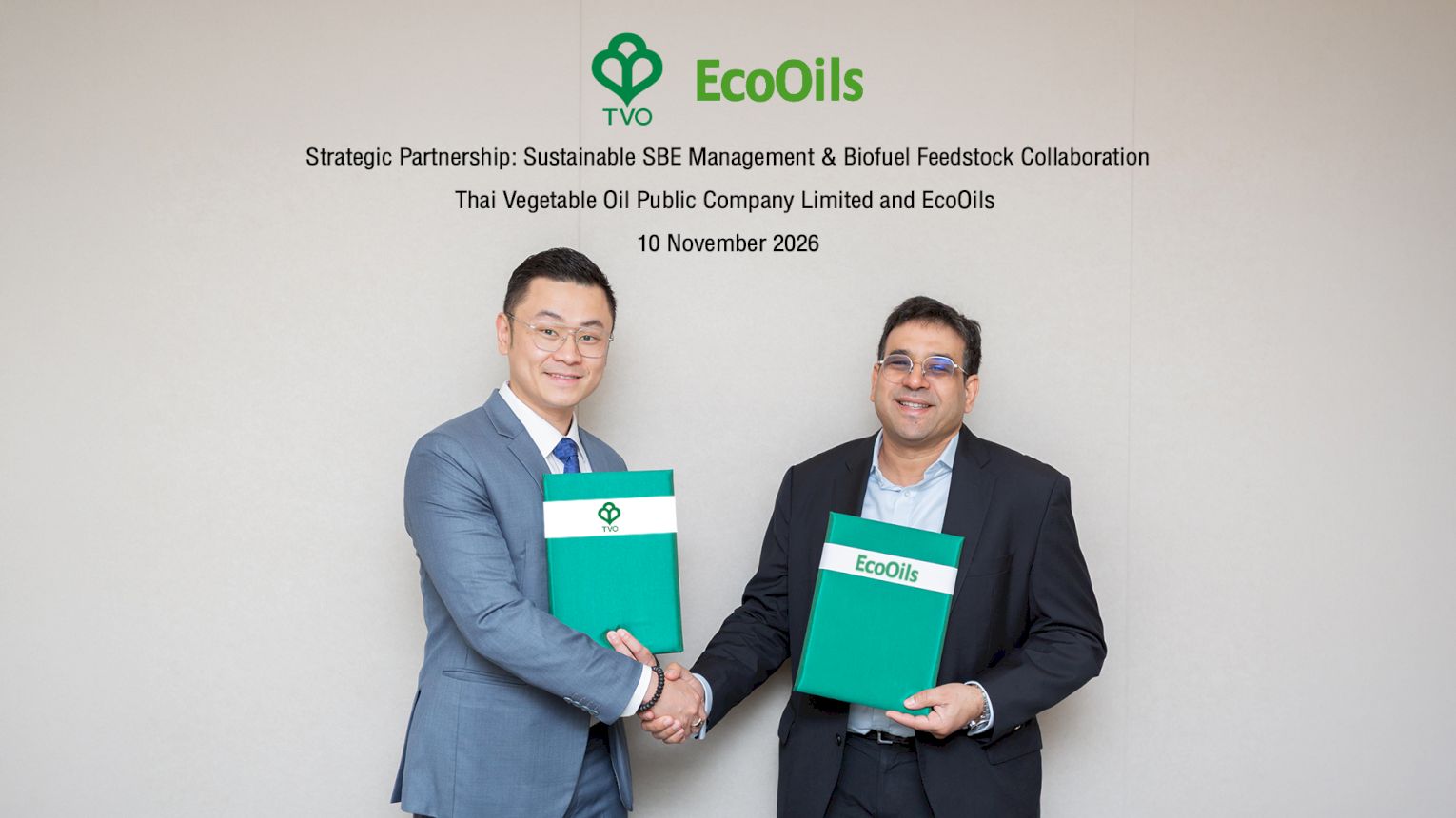
Thai Vegetable Oil Public Company Limited (TVO), represented by Mr. Pachai Chanpitaksa, Chief Executive Officer, and EcoOils Sdn Bhd, a company owned by Shell Eastern Petroleum Pte Ltd, represented by Mr. Rida Sabri, Chief Executive Officer, have signed a Sustainable SBE Supply and Management Agreement under their strategic partnership on sustainable spent bleaching earth (SBE) management and biofuel feedstock collaboration.
The partnership aims to transform by-products from vegetable oil production into valuable resources within the low-carbon energy value chain, establishing a systematic approach to the sustainable management of SBE generated across all TVO production facilities.
Bleaching earth is a naturally occurring mineral clay widely used in the vegetable oil industry as part of the standard oil refining process. After use, the spent bleaching earth (SBE) retains residual oil that can be recovered and used as a waste-based feedstock for biofuel production.
As the global aviation industry increasingly focuses on Sustainable Aviation Fuel (SAF) to support its Net Zero 2050 ambitions, leading airlines worldwide are targeting a 10% share of SAF in their total fuel consumption by 2030.¹ Meanwhile, Thailand began promoting SAF adoption at a blending rate of 0.5–1% for designated international flight routes in 2026.² These developments highlight the growing demand for alternative feedstocks that are sustainable and traceable.
Through this strategic partnership, the two companies will collaborate to unlock greater value from SBE through four key initiatives:
1. Driving the Circular Economy: From By-products to Valuable Resources
TVO is taking SBE utilization to the next level. Previously, SBE was blended with other biomass materials for use as conventional fuel. Under this new approach, the residual oil in SBE will be extracted and used as feedstock for biofuel production, including Sustainable Aviation Fuel (SAF).
The remaining mineral residue will be further processed into Eco-Processed Pozzolan (EPP), an alternative cementitious material, as well as Eco-Mineral (EM), which can be used for soil improvement and brick manufacturing. This comprehensive approach supports TVO's Zero Waste Discharge ambition, ensuring that no part of the material is sent to landfill.
2. Supporting Climate Action and the Transition to Cleaner Energy
Recovering oil from SBE for use as feedstock in Sustainable Aviation Fuel (SAF) production represents another promising pathway to help reduce greenhouse gas emissions. According to reference data from the International Civil Aviation Organization (ICAO), SAF produced from soybean oil through the Hydroprocessed Esters and Fatty Acids (HEFA) pathway can achieve approximately 26% lower lifecycle greenhouse gas emissions compared with conventional fossil-based jet fuel.³ Actual emission reductions vary depending on the feedstock and production process.
3. Strengthening Supply Chain Transparency and Traceability through ISCC EU
TVO is preparing to align its SBE management practices with the International Sustainability and Carbon Certification (ISCC EU) requirements. This involves strengthening systems for SBE collection, transportation and traceability, ensuring that every tonne of SBE can be transparently tracked from its originating production facility to the downstream fuel producer.
4. Cross-Industry Collaboration to Advance the Transition towards Net Zero
By connecting residual materials from TVO's production processes with EcoOils' advanced recycling operations, the partnership demonstrates how resources can be utilized more efficiently across the food and energy industries, creating value through cross-industry collaboration.
The partnership brings together the complementary strengths of both companies. As a leading vegetable oil producer with a commitment to sustainable upstream supply chain management, TVO will be responsible for collecting and supplying traceable SBE. Meanwhile, EcoOils, with over 40 years of expertise in SBE solvent extraction technology, will oversee the processing of SBE and facilitate its integration into downstream markets.
“For nearly 60 years, TVO has recognized the value of every single soybean, making the most of every part — from soybean oil and meal to the by-products and residual materials generated throughout the production process.
Our partnership with EcoOils enables spent bleaching earth (SBE) from all our production facilities to be transformed into valuable feedstock for low-carbon energy production through a systematic and traceable process, with no material sent to landfill. The journey towards Net Zero is not one that any organization can undertake alone. By connecting quality feedstock from the food industry with the clean energy supply chain, this partnership marks another important step towards creating lasting value for society and the environment.”
— Mr. Pachai Chanpitaksa, Chief Executive Officer of Thai Vegetable Oil Public Company Limited (TVO)
“This collaboration reflects the growing importance of circular resource management within the food and agri-processing sectors. By converting spent bleaching earth into a sustainable feedstock for renewable energy production, we are not only reducing waste but also supporting the development of a more resilient and low-carbon supply chain. We are proud to partner with TVO in driving this positive environmental impact.”
— Mr. Rida Sabri, Chief Executive Officer of EcoOils Sdn Bhd
This partnership marks another important step in TVO’s journey towards its 60th year in 2027, while reinforcing the company’s commitment to sustainable business practices. This includes its targets to reduce Scope 1 and Scope 2 greenhouse gas emissions by 47% by 2035 and achieve Net Zero by 2050
